
Digital marketing has become one of the most important skills for businesses, entrepreneurs, and professionals in today’s digital-first economy. From search engines and social media to paid advertising, content marketing, analytics, and artificial intelligence, businesses increasingly depend on digital channels to reach their target audiences and generate measurable results.
This growing demand has also created exciting career opportunities for students, fresh graduates, working professionals, freelancers, and entrepreneurs who want to build skills in digital marketing.
For aspiring marketers in Mumbai, choosing the right training institute is an important decision. A good digital marketing course should go beyond theoretical concepts and provide exposure to practical tools, real-world campaigns, industry practices, analytics, and emerging technologies.
This is where DGmark Institute positions itself as a practical digital marketing training provider in Mumbai.
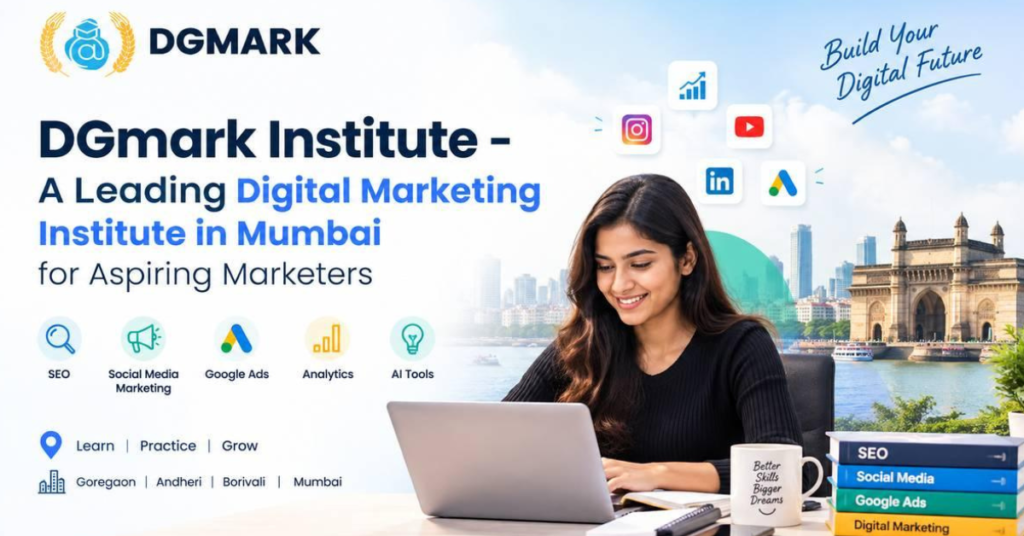
DGmark Institute offers digital marketing programs designed around practical learning, industry-relevant skills, hands-on projects, mentorship, and career-oriented training. Its website currently lists learning centres in Mumbai including Goregaon, Andheri, and Borivali, along with online learning options.
The institute’s programs cover areas such as Search Engine Optimization (SEO), Social Media Marketing, Google Ads, Performance Marketing, Analytics, AI tools, content marketing, website development, and other important components of digital marketing.
For someone searching for a digital marketing institute in Mumbai, the key question is not simply which institute offers a course. The more important question is:
Which institute can help you develop practical skills that can actually be applied in the real digital marketing industry?
This article explores what makes DGmark Institute an option for aspiring marketers and what students should consider when choosing digital marketing training in Mumbai.
What Is Digital Marketing?
Before understanding the role of a digital marketing institute, it is important to understand what digital marketing actually means.
Digital marketing refers to the promotion of products, services, businesses, and brands through digital channels. These channels can include search engines, websites, social media platforms, email, online advertising networks, video platforms, and other digital technologies.
Unlike traditional marketing, digital marketing allows businesses to reach specific audiences, measure campaign performance, test different strategies, and optimize campaigns based on data.
Some of the major areas of digital marketing include:
- Search Engine Optimization (SEO)
- Search Engine Marketing (SEM)
- Google Ads
- Social Media Marketing
- Social Media Advertising
- Content Marketing
- Email Marketing
- Affiliate Marketing
- Performance Marketing
- Influencer Marketing
- Website Development
- Google Analytics and Marketing Analytics
- Conversion Rate Optimization
- E-commerce Marketing
- Artificial Intelligence in Marketing
A modern digital marketer therefore needs more than knowledge of social media or advertising. The role increasingly requires a combination of marketing strategy, creativity, technology, analytics, communication, and problem-solving skills.
This is one reason structured training can be useful for people who want to enter the industry.
Why Choose Digital Marketing as a Career?
The digital economy has created a wide range of roles for professionals with different interests and skill sets.
Someone who enjoys writing may explore content marketing or SEO.
A creative person may be interested in social media, graphic design, or content creation.
Someone who enjoys numbers and performance analysis may prefer paid advertising, marketing analytics, or performance marketing.
Similarly, entrepreneurs can use digital marketing skills to promote their own businesses, while freelancers can offer specialized marketing services to clients.
This flexibility makes digital marketing an attractive career option for many different types of learners.
Some popular career roles include:
SEO Specialist:
Focuses on improving a website’s visibility in search engines through on-page, off-page, technical, and content-related strategies.
Social Media Specialist:
Develops social media strategies, creates content, manages communities, and analyzes engagement across social platforms.
Performance Marketer:
Works with paid advertising campaigns and focuses on measurable outcomes such as leads, sales, conversions, and return on advertising spend.
Google Ads Specialist:
Creates, manages, and optimizes advertising campaigns across Google’s advertising ecosystem.
Content Marketer:
Develops useful and strategic content to attract, educate, engage, and convert audiences.
Digital Marketing Executive:
Works across multiple digital marketing functions and supports the execution of online campaigns.
Freelance Digital Marketer:
Provides digital marketing services independently to businesses, entrepreneurs, agencies, or personal brands.
The variety of career paths means that students don’t necessarily have to follow one fixed route after learning digital marketing.
DGmark Institute: Building Practical Digital Marketing Skills
When evaluating a digital marketing institute in Mumbai, one of the most important factors to consider is the balance between theory and practical implementation.
DGmark Institute emphasizes practical and industry-oriented learning. According to its official website, its approach includes hands-on projects, expert mentorship, live campaign exposure, and real-world learning.
The institute describes its curriculum as continuously updated with areas such as AI tools, performance marketing strategies, SEO developments, and real-time case studies.
This practical approach is particularly important because digital marketing is an execution-driven field.
Knowing what SEO means is different from actually performing keyword research, optimizing a webpage, analyzing search performance, identifying technical issues, and developing a content strategy.
Similarly, knowing what Google Ads is does not automatically mean someone can create an effective campaign.
Practical training helps bridge that gap.
What Makes DGmark Institute Different?
There are many factors students should evaluate before joining a digital marketing course.
These include the curriculum, practical exposure, trainers, learning environment, course duration, certification, career support, location, and opportunities to work on projects.
DGmark Institute’s training approach focuses on combining these elements.
1. Industry-Relevant Curriculum
Digital marketing changes continuously.
Search engine algorithms evolve. Advertising platforms introduce new features. Social media trends change. AI tools are transforming content creation and marketing workflows.
A course that relies entirely on outdated examples can therefore leave students unprepared for current industry requirements.
DGmark Institute states that its curriculum is updated with current digital marketing developments, including AI tools, performance marketing, analytics, and other emerging areas.
Its published curriculum includes a broad range of modules covering areas such as digital marketing fundamentals, social media marketing, Canva graphic design, AI tools, SEO, advertising, analytics, e-commerce marketing, and more.
This broad curriculum can help learners understand how different components of digital marketing work together.
2. Practical Learning Approach
Digital marketing is a skill-based profession.
A student may understand marketing terminology after reading a textbook, but employers and clients also expect the ability to execute campaigns and solve practical problems.
For example, an aspiring SEO professional should ideally understand how to:
- Conduct keyword research
- Analyze search intent
- Optimize website pages
- Create SEO-friendly content
- Understand technical SEO fundamentals
- Build internal linking strategies
- Analyze search performance
- Monitor competitors
Similarly, someone interested in paid advertising should understand campaign structure, targeting, ad creatives, budgets, bidding, conversion tracking, and campaign optimization.
DGmark Institute highlights practical learning through live campaigns, projects, case studies, and hands-on exposure as part of its training approach.
This emphasis on execution can be particularly valuable for beginners who have little professional experience.
3. AI-Integrated Digital Marketing Training
Artificial intelligence has become an increasingly important part of the modern marketing ecosystem.
AI tools can assist marketers with research, brainstorming, content creation, data analysis, automation, customer insights, campaign optimization, and productivity.
However, learning AI in isolation is not enough.
The real value comes from understanding how AI can be integrated into a broader marketing strategy.
DGmark Institute’s current course information highlights AI-integrated learning and includes multiple AI tools within its curriculum. Its website also references areas such as AI optimization, automation, and AI-supported marketing workflows.
For aspiring marketers, this can help develop an important mindset:
AI should support marketing expertise—not replace marketing thinking.
A successful digital marketer still needs to understand audiences, positioning, branding, customer psychology, campaign objectives, creativity, data, and business goals.
4. Multiple Learning Options
Different learners have different requirements.
A student may prefer classroom-based training, while a working professional may require a flexible schedule or online learning option.
DGmark Institute currently lists classroom programs as well as an online digital marketing program. Its website also lists a six-month Certification in Advanced Digital Marketing and a 12-month Diploma in Advanced Digital Marketing, alongside an online program.
The institute has learning centres in Mumbai, including:
- Goregaon
- Andheri
- Borivali
Its website also currently lists Mira Road among its learning-centre locations.
Having multiple locations can make classroom learning more accessible for students across different parts of Mumbai.
5. Training for Different Types of Learners
Digital marketing isn’t limited to one particular educational background.
A student, graduate, working professional, entrepreneur, or aspiring freelancer can potentially benefit from digital marketing knowledge depending on their objectives.
DGmark Institute specifically describes its programs as being suitable for job seekers, working professionals, and business owners.
For Students
Students can use digital marketing training to develop practical skills alongside their academic education.
Instead of entering the job market with only theoretical knowledge, they can work toward developing skills in SEO, advertising, social media, analytics, content, and other digital marketing disciplines.
For Working Professionals
Professionals from sales, marketing, communications, business development, or other backgrounds can add digital marketing skills to their existing experience.
This can help them explore new responsibilities or transition toward digital-focused roles.
For Entrepreneurs
Business owners can learn how digital channels work and understand how to promote their businesses online.
Knowledge of SEO, social media, advertising, content, and analytics can help entrepreneurs make more informed marketing decisions.
For Freelancers
Digital marketing can also provide opportunities for individuals interested in freelancing.
A freelancer can specialize in areas such as SEO, social media management, paid advertising, content marketing, website development, or other digital services.
DGmark Institute and the Mumbai Digital Marketing Ecosystem
Mumbai is one of India’s major commercial and business hubs.
The city has a diverse ecosystem of startups, agencies, established companies, entrepreneurs, e-commerce businesses, media organizations, and service providers.
This creates a natural environment for digital marketing professionals.
Businesses across industries need digital visibility. Whether it is a local restaurant trying to attract customers through Google and social media, a startup running performance campaigns, an e-commerce company generating online sales, or a professional building a personal brand, digital marketing plays an important role.
For aspiring marketers, learning in such an environment can provide exposure to the types of marketing challenges businesses face.
DGmark Institute’s Mumbai centres are positioned in areas including Goregaon, Andheri, and Borivali, giving students access to classroom-based digital marketing training across different parts of the city.
DGmark Institute’s Digital Marketing Course Curriculum
One of the most important things to evaluate before selecting a digital marketing institute in Mumbai is the curriculum.
Digital marketing is not a single skill. It is a combination of multiple disciplines that work together to help businesses attract audiences, generate leads, build brands, and increase conversions.
DGmark Institute’s published course information covers several core areas of digital marketing, including SEO, social media marketing, Google Ads, analytics, content marketing, AI tools, e-commerce marketing, and other practical areas. Explore DGmark Institute’s official course information
A comprehensive curriculum can help students understand the complete digital marketing ecosystem rather than learning isolated tools.
Digital Marketing Fundamentals
The foundation of any successful marketing strategy is understanding the fundamentals.
Students need to understand concepts such as:
- Digital marketing channels
- Customer journeys
- Target audiences
- Buyer personas
- Marketing funnels
- Lead generation
- Conversion optimization
- Online branding
- Campaign planning
- Marketing objectives
Understanding these fundamentals makes it easier to connect individual marketing activities with broader business goals.
Search Engine Optimization (SEO)
SEO is one of the most important components of digital marketing.
Search Engine Optimization helps businesses improve their visibility on search engines and attract relevant organic traffic.
A strong SEO learning program should cover different aspects of optimization, including:
- Keyword research
- Search intent
- On-page SEO
- Technical SEO
- Off-page SEO
- Content optimization
- Internal linking
- Competitor analysis
- Local SEO
- SEO analytics
For example, imagine a Mumbai-based business that offers interior design services.
Instead of relying entirely on paid advertising, the business could create optimized pages targeting searches related to interior designers in Mumbai, home interior design, office interiors, and other relevant topics.
The SEO professional’s role is to understand what potential customers are searching for and develop a strategy that helps the business become more visible for relevant searches.
This makes SEO an important skill for anyone planning a career in digital marketing.
Social Media Marketing
Social media has transformed how businesses communicate with their audiences.
Platforms such as Instagram, Facebook, LinkedIn, YouTube, and other social networks provide businesses with opportunities to build awareness, engage communities, distribute content, and generate leads.
However, simply posting content isn’t a complete social media strategy.
A professional social media marketer needs to understand:
- Audience research
- Content strategy
- Content pillars
- Social media calendars
- Copywriting
- Creative strategy
- Engagement
- Community management
- Social media analytics
- Paid social campaigns
- Brand positioning
DGmark Institute includes social media marketing within its broader digital marketing curriculum, helping learners understand another major component of the digital ecosystem. DGmark Institute digital marketing programs
For aspiring social media professionals, practical experience is especially valuable because social platforms are highly execution-oriented.
Google Ads and Paid Advertising
Organic marketing is only one side of digital marketing.
Businesses also invest in paid advertising to reach potential customers more quickly and generate measurable outcomes.
Google Ads is an important part of the paid marketing ecosystem.
Students learning paid advertising should understand concepts such as:
- Campaign objectives
- Keyword targeting
- Search campaigns
- Display advertising
- Audience targeting
- Ad copy
- Landing pages
- Conversion tracking
- Bidding strategies
- Campaign optimization
- Performance measurement
The objective isn’t simply to create an advertisement.
The marketer needs to understand who should see the advertisement, what message should be presented, where users should be directed, and whether the campaign is producing the desired business result.
This is why practical exposure to advertising platforms can be valuable for aspiring performance marketers.
Performance Marketing
Performance marketing focuses heavily on measurable results.
Instead of looking only at impressions or reach, performance marketers often evaluate metrics such as:
- Leads
- Sales
- Conversions
- Cost per lead
- Cost per acquisition
- Conversion rate
- Return on ad spend
- Customer acquisition cost
For example, suppose a company spends ₹50,000 on an advertising campaign.
A performance marketer shouldn’t simply report that the campaign received thousands of impressions.
They should investigate:
How many people clicked?
How many converted?
What was the cost per lead?
Which audience performed best?
Which advertisement generated the strongest results?
What can be optimized in the next campaign?
This analytical mindset is an important part of modern digital marketing.
DGmark Institute’s course information highlights performance marketing as part of its training approach, making it relevant for learners interested in measurable digital campaigns. DGmark Institute course details
Digital Marketing Analytics
Marketing without measurement can become guesswork.
Analytics helps marketers understand what is working, what isn’t working, and where improvements can be made.
A digital marketing student should therefore develop familiarity with data and reporting.
Important areas include:
- Website traffic
- User behaviour
- Traffic sources
- Campaign performance
- Conversions
- Engagement metrics
- Search performance
- Advertising metrics
- ROI analysis
Analytics also helps marketers communicate their value to businesses.
For example, instead of saying:
“Our campaign performed well.”
A marketer can present measurable information about traffic, leads, conversions, acquisition costs, and other relevant KPIs.
This makes marketing more accountable and business-focused.
Content Marketing and Copywriting
Content remains an important part of digital marketing.
Blogs, social media posts, videos, landing pages, email campaigns, advertisements, product descriptions, and other forms of content help brands communicate with their audiences.
But effective content isn’t simply about writing frequently.
Good content should have a purpose.
Depending on the marketing objective, content may be designed to:
- Generate awareness
- Educate customers
- Build trust
- Answer questions
- Generate leads
- Drive website traffic
- Support SEO
- Encourage conversions
- Strengthen brand authority
For aspiring digital marketers, developing content and copywriting skills can therefore provide an important advantage.
Artificial Intelligence in Digital Marketing
AI is changing how marketers approach everyday tasks.
From brainstorming content ideas to analyzing information, creating marketing workflows, generating initial drafts, assisting with research, and improving productivity, AI tools can support marketers across different stages of a campaign.
However, effective AI marketing requires more than knowing how to enter prompts into an AI tool.
Marketers need to understand:
What should AI be used for?
What should remain under human control?
How should AI-generated output be evaluated?
How can AI improve marketing efficiency without reducing quality?
DGmark Institute’s current course information incorporates AI tools and AI-focused learning into its digital marketing curriculum. DGmark Institute’s official website
For students entering digital marketing in 2026, understanding AI alongside traditional marketing fundamentals can be particularly relevant.
Live Projects and Practical Exposure
One of the biggest differences between learning digital marketing theoretically and learning it practically is execution.
Imagine learning how to ride a bicycle by reading a 300-page book.
You may understand the theory, but you still need to get on the bicycle.
Digital marketing works in a similar way.
You can learn what SEO is, understand what Google Ads does, and memorize social media terminology. But practical experience helps you understand what happens when you actually implement a strategy.
DGmark Institute emphasizes practical learning through projects, campaigns, case studies, and hands-on exposure. DGmark Institute’s practical digital marketing training
Practical projects can help students become familiar with the workflow of a digital marketing campaign.
For example:
Research → Strategy → Execution → Measurement → Optimization
This process is at the heart of professional digital marketing.
Certifications and Career Development
Certifications can be useful additions to a digital marketer’s professional profile.
They can demonstrate that a learner has completed structured training and developed knowledge in specific areas.
However, a certificate alone doesn’t make someone a successful digital marketer.
Employers and clients also look for practical skills, communication abilities, analytical thinking, creativity, adaptability, and the ability to execute marketing activities.
DGmark Institute offers certification-oriented digital marketing programs, including its listed advanced digital marketing certification and diploma programs. DGmark Institute official programs
The ideal approach is therefore to view certification as one part of professional development, alongside practical experience and a strong portfolio.
Placement Assistance and Career Support
For many students, joining a digital marketing course isn’t only about learning.
They also want to understand what happens after the training.
Career support can be valuable for beginners who don’t yet know how to approach employers, prepare their resumes, build portfolios, or present their digital marketing skills during interviews.
DGmark Institute promotes career-oriented training and placement assistance as part of its offering. DGmark Institute’s official website
Students should nevertheless approach placement claims thoughtfully and evaluate the specific support offered by an institute before enrolling.
Important questions to consider include:
- Does the institute provide interview preparation?
- Is resume guidance available?
- Are students given practical projects?
- Can students build a portfolio?
- Is interview assistance provided?
- Are career-related sessions included?
- What kind of roles are students preparing for?
These questions can help learners make a more informed decision.
Who Should Join DGmark Institute?
A digital marketing program can be useful for people at different stages of their careers.
Students and Fresh Graduates
Students who want to enter the marketing industry can use digital marketing training to develop practical skills before applying for jobs.
Learning SEO, social media, paid advertising, analytics, content, and other areas can help students understand the broader marketing ecosystem.
Working Professionals
Professionals who already have experience in sales, marketing, business development, communication, or related areas can add digital marketing skills to their existing expertise.
This can help them adapt to increasingly digital marketing environments.
Entrepreneurs and Business Owners
Business owners don’t necessarily need to become full-time digital marketers.
However, understanding digital marketing can help them make better decisions when working with agencies, freelancers, or internal marketing teams.
Freelancers
Freelancing is another potential career path.
A trained professional can specialize in a specific area such as:
- SEO
- Social media
- Google Ads
- Content marketing
- Website development
- Performance marketing
- Local SEO
Specialization can help freelancers develop a clear service offering and target specific types of clients.
How to Choose the Right Digital Marketing Institute in Mumbai
Mumbai has numerous digital marketing training providers.
Therefore, selecting the right institute requires more than searching for the cheapest course or the institute with the most attractive advertisement.
Before enrolling, consider these factors.
1. Check the Curriculum
Make sure the course covers the areas you actually want to learn.
A comprehensive curriculum should ideally include core skills such as SEO, social media, paid advertising, analytics, content marketing, and emerging technologies.
2. Look for Practical Training
Ask whether students get opportunities to work on projects and campaigns.
Practical experience can make a significant difference when transitioning from classroom learning to professional work.
3. Evaluate Trainers
Experienced trainers can provide context that isn’t always available in textbooks.
Look for instructors who can explain concepts using practical examples and current industry scenarios.
4. Understand the Course Structure
Consider:
- Duration
- Class schedule
- Classroom or online format
- Batch size
- Learning resources
- Project structure
- Assessments
- Certification
5. Consider Location
If you prefer classroom training, location matters.
DGmark Institute currently lists centres in several Mumbai locations, including Goregaon, Andheri, and Borivali. DGmark Institute locations
6. Ask About Career Support
If your objective is employment, understand exactly what career assistance is provided.
Don’t evaluate an institute solely on the word “placement.” Look at the actual career-support process.
Career Opportunities After Digital Marketing Training
Completing a digital marketing course doesn’t mean everyone will follow the same career path.
Depending on their interests and skills, learners can explore several roles.
SEO Executive
An SEO executive works on improving website visibility through search engine optimization.
Social Media Executive
A social media executive manages content, campaigns, engagement, and social media activities.
Digital Marketing Executive
A digital marketing executive may work across several marketing channels and support overall digital campaigns.
Performance Marketing Executive
This role focuses on paid campaigns, conversions, optimization, and measurable performance.
PPC/Google Ads Specialist
A PPC specialist focuses on paid search campaigns and related advertising activities.
Content Marketing Specialist
Content specialists develop strategic content for websites, social media, email, and other channels.
Digital Marketing Freelancer
Freelancers can provide specialized marketing services directly to businesses and entrepreneurs.
Entrepreneur
Business owners can also use digital marketing knowledge to build and promote their own brands.
The right career direction ultimately depends on an individual’s interests, strengths, experience, and willingness to keep learning.
Why DGmark Institute Can Be Considered by Aspiring Marketers
Choosing a digital marketing institute in Mumbai is an important investment of time and money.
DGmark Institute offers a broad digital marketing curriculum, practical learning components, AI-related training, classroom locations in Mumbai, online learning options, and career-oriented programs. DGmark Institute
Its focus on multiple areas of digital marketing can be useful for learners who want to understand the industry as a whole rather than specialize immediately in a single channel.
At the same time, prospective students should evaluate the course according to their own goals.
A student looking for a first job may prioritize practical projects and career preparation.
A business owner may care more about learning advertising, SEO, social media, and analytics.
A freelancer may prioritize specialization and portfolio development.
The best course is therefore not necessarily the one with the longest list of features. It is the one that aligns with your career objective, learning style, budget, and practical requirements.
Final Thoughts
Digital marketing is evolving rapidly, and the marketers entering the industry today need to be prepared to continuously learn.
SEO is changing.
Advertising platforms are becoming more automated.
Social media behaviour continues to evolve.
Analytics is becoming increasingly important.
And artificial intelligence is transforming how marketers work.
For aspiring marketers in Mumbai, structured education can provide a starting point for understanding these different areas and developing practical skills.
DGmark Institute is one option for learners looking for structured digital marketing training in Mumbai, with programs covering major areas of digital marketing and an emphasis on practical, career-oriented learning. Visit DGmark Institute’s official website
Ultimately, becoming a successful digital marketer doesn’t happen simply by completing a course.
It requires learning, practicing, experimenting, analyzing results, building projects, developing a portfolio, and continuously adapting to changes in the industry.
For someone serious about building a career in digital marketing, the journey can begin with the right foundation—and the right training environment can make that journey more structured and practical.